In my English 8 class, we often read mentor texts before diving into a study of genre. A notable example of this is when we work on Science Fiction. Before studying the inner workings of this genre, we read short stories written by Ray Bradbury. It is only after having read short stories that we jump into our unit on what Science Fiction is and how we can write it.
For this assignment, I worked with creating a pre-assessment that would transition students from our work with “The Veldt” (a sci-fi short story by Bradbury) into our work with sci-fi. Having them read the story on their own, I would then use this as an entry point into our genre work. My pre-assessment would consist of a non-graded Google Quiz (made with Google Forms). Each student would answer a series of questions (True/False, Multiple Choice, and Free Response). Here is what the quiz looks like:
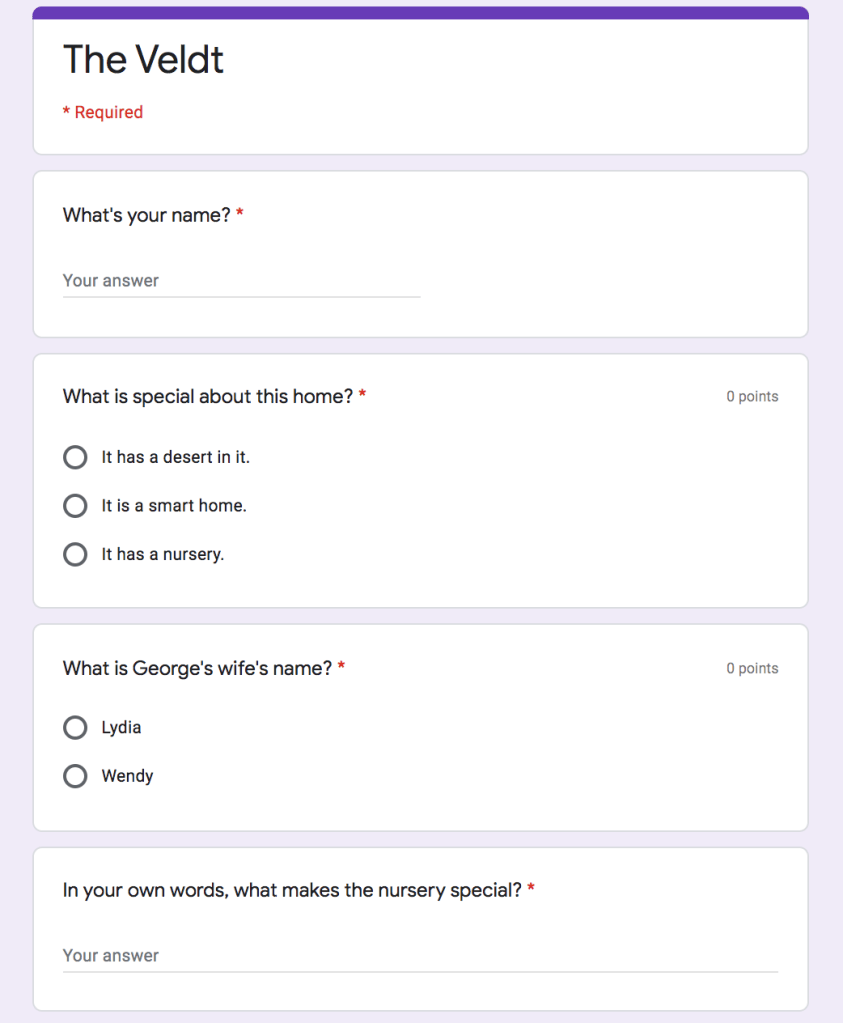
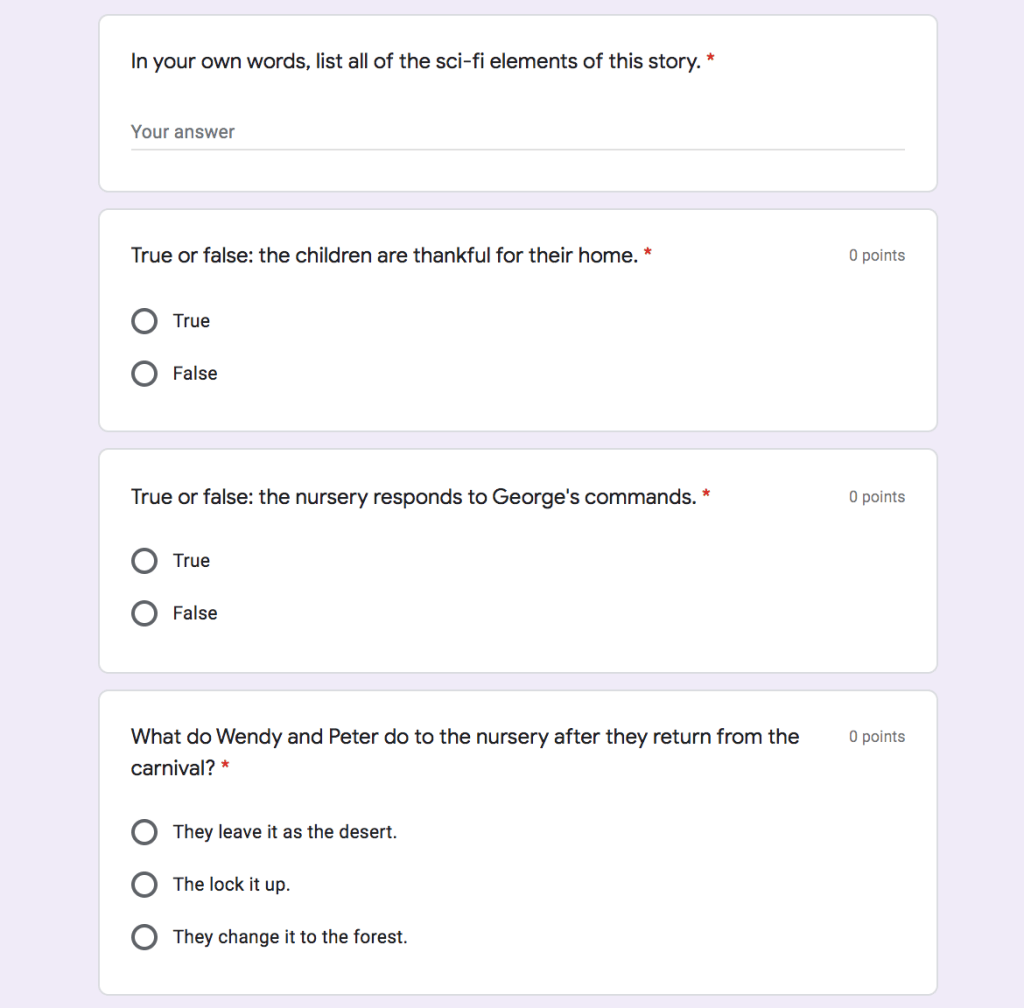
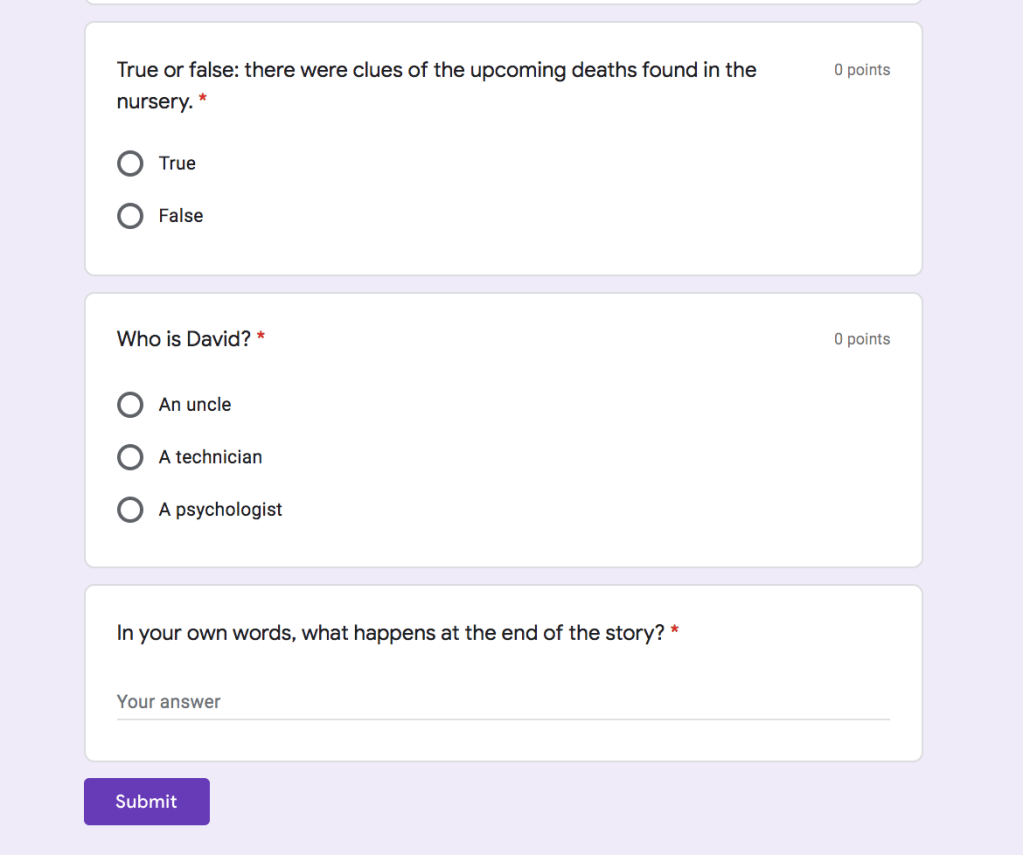
There are two goals to this pre-assessment. First, I would want to check for reading comprehension. Second, I would want to see what students know about Science Fiction as a genre. There are a few questions (the elements of sci-fi, what makes the nursery special, and the ending) that hit on this knowledge of genre.
To group my students, I would have them watch a video on Ray Bradbury. While they watch, I would analyze the results (mostly corrected by Google, except for free response). Students who understood more than 85% of content would be placed in the advanced group in terms of understanding (Group 1). They would understand both content and genre. Students who scored between 60% and 85% would be in the middle group in terms of understanding (Group 2). They would understand the content of the story, but likely struggle with more abstract thinking in terms of genre. Students who scored less than 60% would be in the lower group (Group 3), as they would not have understood enough to get at the genre. In most cases, these students would be having difficulties with language or reading in general. They would need to first work on reading comprehension in order to then move to genre analysis.
Here is how I would differentiate based on the needs of the different groups:
Group 1: this group of students is already coming into our work with strong reading comprehension skills and an idea of what makes Science Fiction its own genre. They can likely do abstract thinking and look beyond the plot of a story to consider its writing style and trends. This group would need activities that allow them to challenge what they know and play with it. Rather than working on reading comprehension, they need the opportunity to create and explore what they understood.
Group 2: this group of students likely have strong reading comprehension skills. That said, they probably do not know much about genre. When they get a short story, they think of it as isolated from other works. Thus, they would need activities that help guide them to consider the forest (rather than just the individual trees). I would want to push them to take what they understood from a text and see what it means about style and genre.
Group 3: this group of students would have struggled to understand the basics of the plot. For them, considering genre is a far step until they can first comprehend the story itself. In all likelihood, this is the group where students with learning differences and ELL students might place into (just based on the difficulty of the writing of the story and the abstract nature of the task).
Here is the flowchart that I made to show how instruction would vary based on the pre-assessment results:
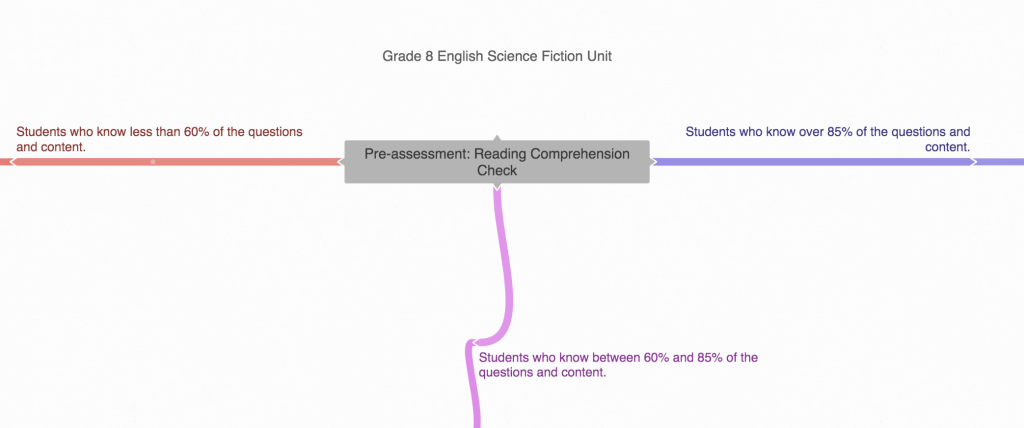
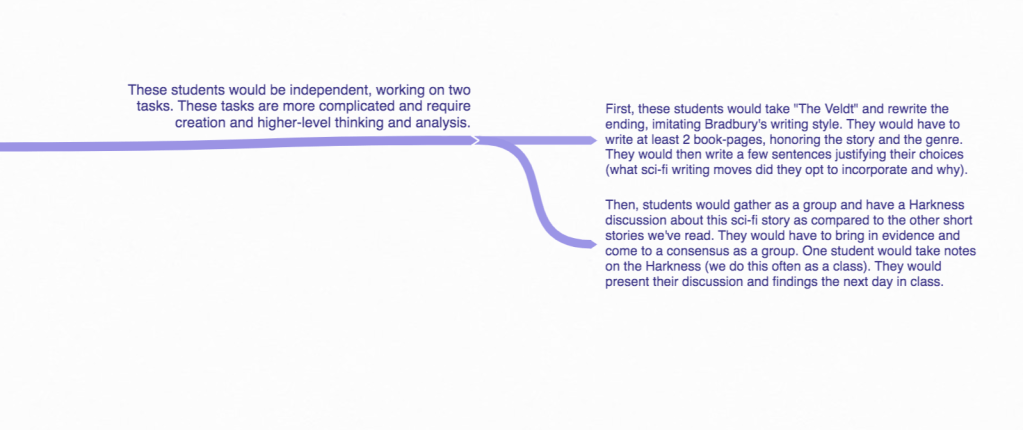
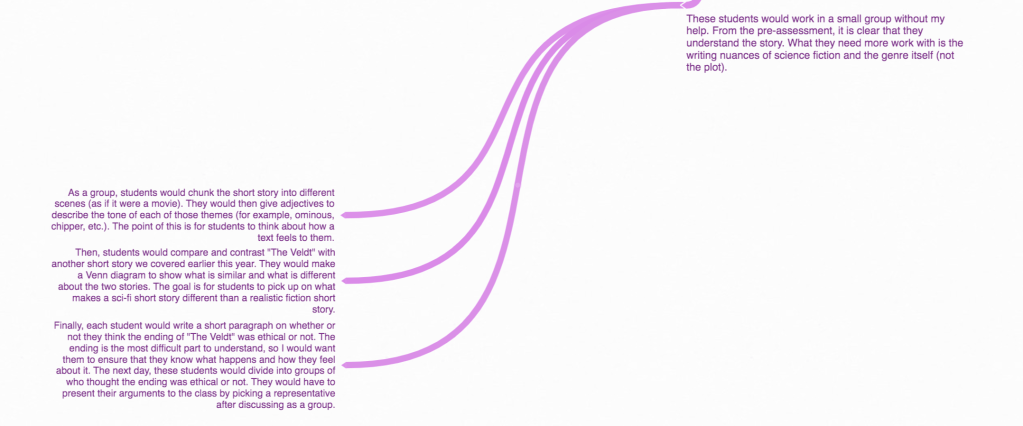
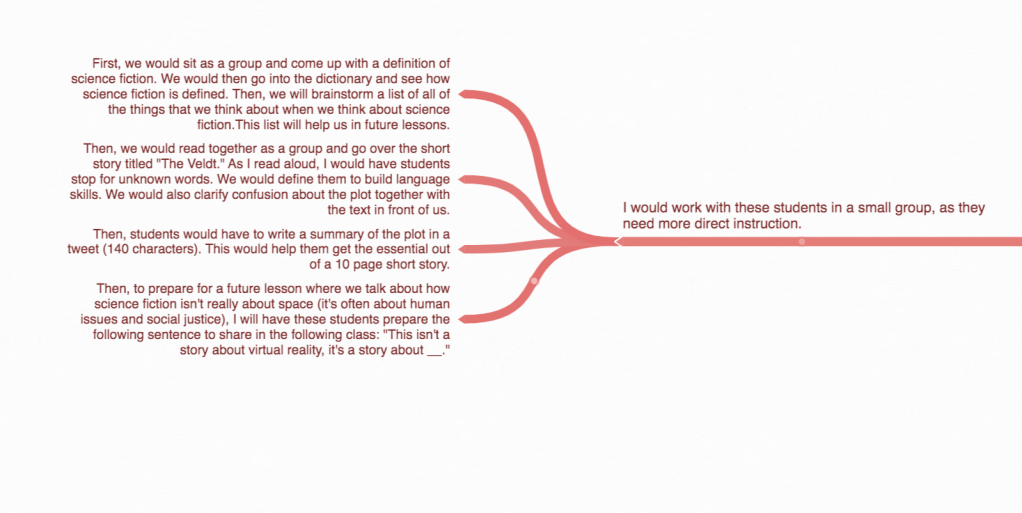
You can also click here to see the flowchart!
Here are the ways in which I would track progress:
For students in Group 1, their progress would appear in two ways. First, their rewriting of the ending of “The Veldt” would show me how they can observe writing techniques for sci-fi and apply these techniques themselves. Their justification sentences would show me what they were aiming to create. I would be able to see how successfully they were able to apply these techniques. Then, their Harkness notes would show me how they work with others to develop a group-understanding of genre.
For students in Group 2, I would see their progress in their Venn Diagram and the paragraphs they write. I want to see them move away from basic reading comprehension and move into analysis. Making a claim about an ending as ethical or not helps them build argumentation skills. Comparing stories and then articulating those differences would help me see how they learn to identify what makes sci-fi unique.
For students in Group 3, I would see their progress through our discussion of the story and through the tweets they write. I would also have them retake the pre-assessment to see if they can show that they grew.
Here is how I would meet the needs of my ELL and special needs students:
There are several ways in which I would support students who are ELL or have special needs. For ELL students, I would allow them to have dictionaries and ask clarifying questions (both for the pre-assessment and the activities that follow). If they are unable to use words to show what they know, I would let them draw it out. As for genre, I think that I would ask students to explore sci-fi on YouTube to get a better idea of what it means. I would ask them if they’ve encountered sci-fi in their native language (movies, tv, books). This would help the abstract discussion feel more accessible.
For students with special needs, I would offer them the chance to speak what they know, rather than write it. Often, it is easier for students to share reading comprehension when it feels like a conversation. Every time, while reading, that they felt something big happened in the plot, I would ask them to stop me and we would discuss it. Furthermore, I would allow special needs students more time to take the pre-assessment. If any of these students struggle with maintaining attention, I would call in a member of our Learning Center so that they wouldn’t have to sit in the Group 3 read aloud of the story. In this way, they could read at their own pace and take breaks to move around as needed.

