I received feedback as well as read and participated in the Discussion Forum. Now what?
One of the things that I appreciate most about working with our Cohort is how supportive everyone is. Often, when I share ideas that I have for activities or forms of formative assessments, I feel unsure of myself. I think that one of the benefits of getting feedback from partners and the forum is that members of our Cohort are able to point out strengths or positive aspects of my work. Likewise, I appreciate our culture of sharing for it pushes me to be a better teacher.
In this activity, I received some very helpful feedback from my two partners, from how specific my instructions were to the possible sensitive nature of the poems I picked to the length of time the formative assessments would take.
Furthermore, in reading and participating in the Discussion Forum, I realized some additional things:
– Websites like Kahoot and Quizlet can help students become extremely motivated. Gamification can really make assessment feel less stressful and more empowering. Sarika wrote about her experience watching her children use Quizlet. I’d love for my formative assessment to be something that students look forward to doing.
– It is easy to avoid tracking growth, as we often are deeply familiar with how students are doing. That said, tracking the growth actively can be important for record-keeping and for students to see proof of how they have changed.
How will I change my assessments?
For my Reading Checks assessment, I still think that they are a good idea. That said, I wanted to incorporate some more gamification so that it is not always a written reading check of three questions. I think reading checks can be great for a quick gauge of how students are doing. I will continue to use them and track them on Google Drive. In addition, I made a Kahoot to summarize all of the important information from the first half of the book. I tried it out with my students and they adored it. They blew me away. Not only were they enthusiastic about the activity (they are extremely competitive), but also they were eager to explain how they knew the correct answers. They shocked me with how much they were able to recall. I think this was a great way to take my original formative assessment and vary it for fun and complexity (and ease of gathering data). Here are some screenshots of results and example questions:
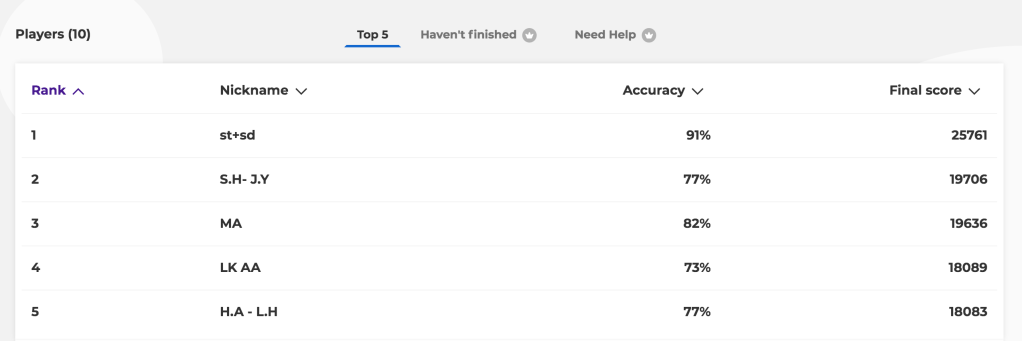
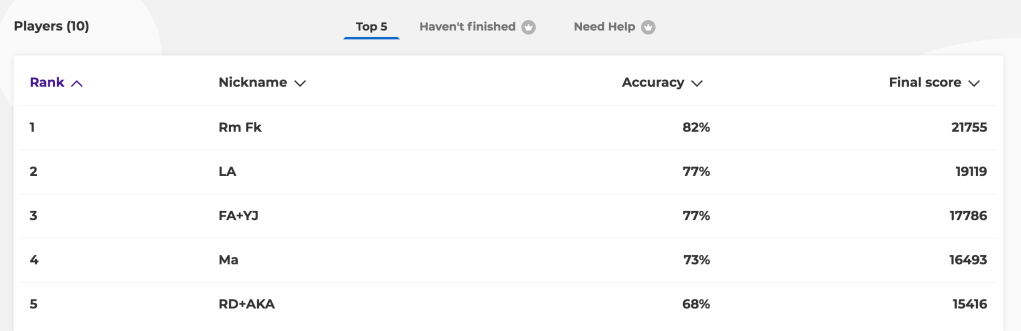
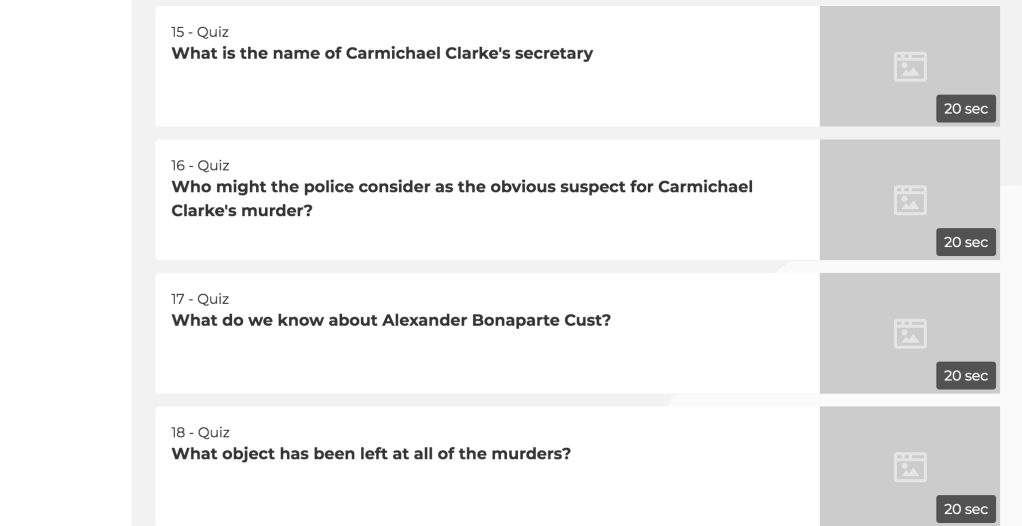
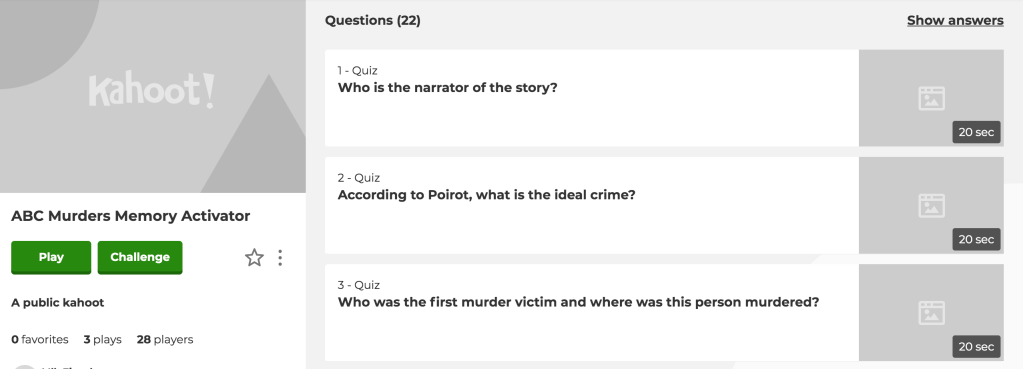
As for my poetry formative assessment, I think that I would want to make it a bit more quick and easy to assess. My idea of a Yes/No/Maybe chart feels more like an appropriate activity to do during the study of the poem. I think I could then shift to a formative assessment where students put dots next to what they believe about the poem or not. This is not to say that I want to get rid of my proposed formative assessment. Rather, I think that what I first proposed helps students articulate what they know/don’t know. Changing this assessment to be a bit more structured and targeted with specific questions would allow me to see if students know certain things I want them to take away from the poem.
Alternatively, I could use a method called “Four Corners” to make statements about the poem and then have students go to a corner if they agree or disagree. Then, they’d have to justify their answer. My students love to debate, and this formative assessment would allow me to gauge their understanding. Here is a great video speaking to this type of activity:
Finally, for my Ed Puzzle, I would need to figure out a way to clarify time expectations. Perhaps I could allow students to do an initial attempt in class under a timed expectation. Then, they could go back home to return to the parts they didn’t understand.
All in all, I’m looking forward to fine-tuning my formative assessments. I think they are crucial both for me and for my students to understand where they are.

