Pre-Assessment for Differentiation

In my English 8 class, we often read mentor texts before diving into a study of genre. A notable example of this is when we work on Science Fiction. Before studying the inner workings of this genre, we read short stories written by Ray Bradbury. It is only after having read short stories that we jump into our unit on what Science Fiction is and how we can write it.

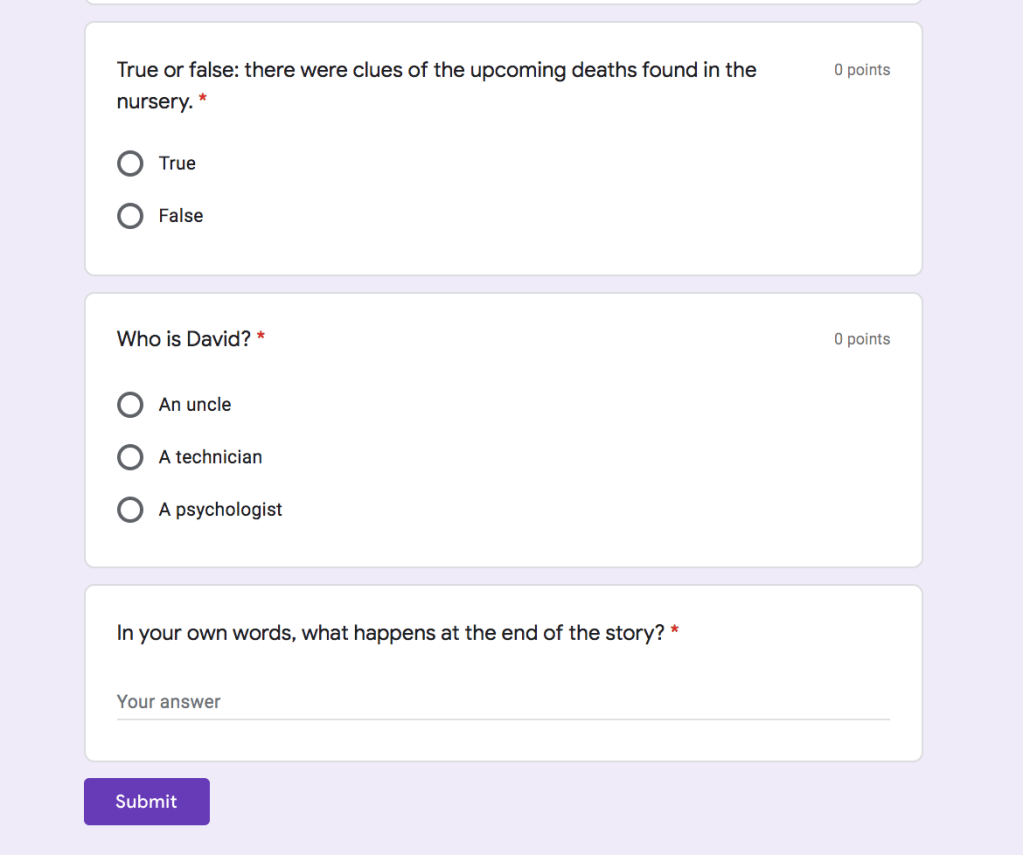
For this assignment, I worked with creating a pre-assessment that would transition students from our work with “The Veldt” (a sci-fi short story by Bradbury) into our work with sci-fi. Having them read the story on their own, I would then use this as an entry point into our genre work. My pre-assessment would consist of a non-graded Google Quiz (made with Google Forms). Each student would answer a series of questions (True/False, Multiple Choice, and Free Response). Here is what the quiz looks like:
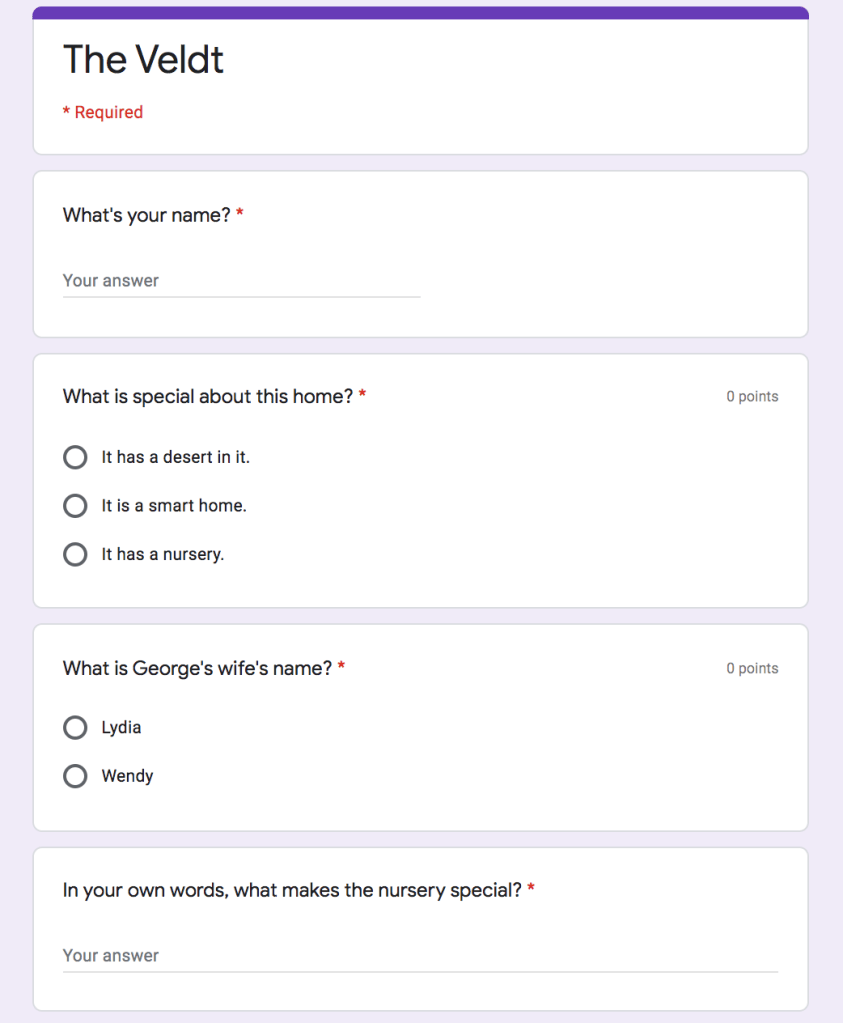
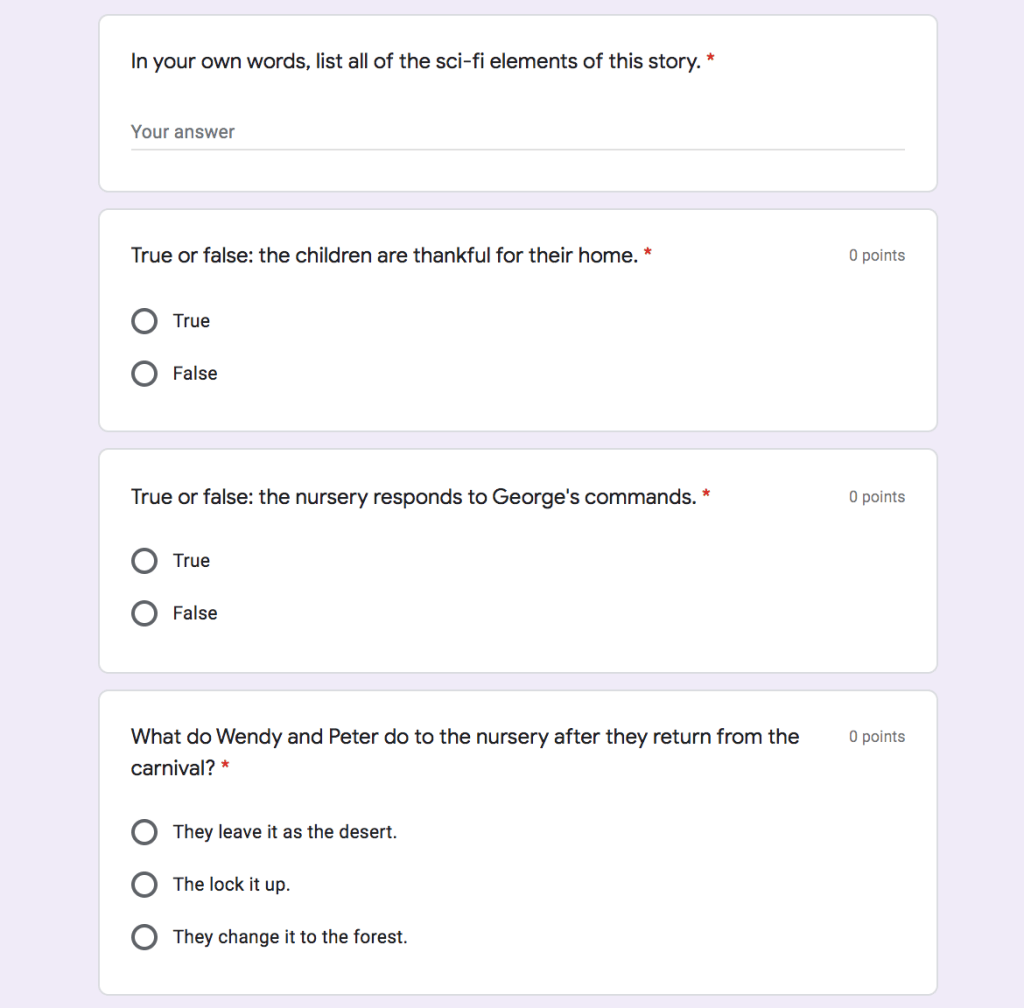
There are two goals to this pre-assessment. First, I would want to check for reading comprehension. Second, I would want to see what students know about Science Fiction as a genre. There are a few questions (the elements of sci-fi, what makes the nursery special, and the ending) that hit on this knowledge of genre.

To group my students, I would have them watch a video on Ray Bradbury. While they watch, I would analyze the results (mostly corrected by Google, except for free response). Students who understood more than 85% of content would be placed in the advanced group in terms of understanding (Group 1). They would understand both content and genre. Students who scored between 60% and 85% would be in the middle group in terms of understanding (Group 2). They would understand the content of the story, but likely struggle with more abstract thinking in terms of genre. Students who scored less than 60% would be in the lower group (Group 3), as they would not have understood enough to get at the genre. In most cases, these students would be having difficulties with language or reading in general. They would need to first work on reading comprehension in order to then move to genre analysis.

Here is how I would differentiate based on the needs of the different groups:

Group 1: this group of students is already coming into our work with strong reading comprehension skills and an idea of what makes Science Fiction its own genre. They can likely do abstract thinking and look beyond the plot of a story to consider its writing style and trends. This group would need activities that allow them to challenge what they know and play with it. Rather than working on reading comprehension, they need the opportunity to create and explore what they understood.

Group 2: this group of students likely have strong reading comprehension skills. That said, they probably do not know much about genre. When they get a short story, they think of it as isolated from other works. Thus, they would need activities that help guide them to consider the forest (rather than just the individual trees). I would want to push them to take what they understood from a text and see what it means about style and genre.

Group 3: this group of students would have struggled to understand the basics of the plot. For them, considering genre is a far step until they can first comprehend the story itself. In all likelihood, this is the group where students with learning differences and ELL students might place into (just based on the difficulty of the writing of the story and the abstract nature of the task).

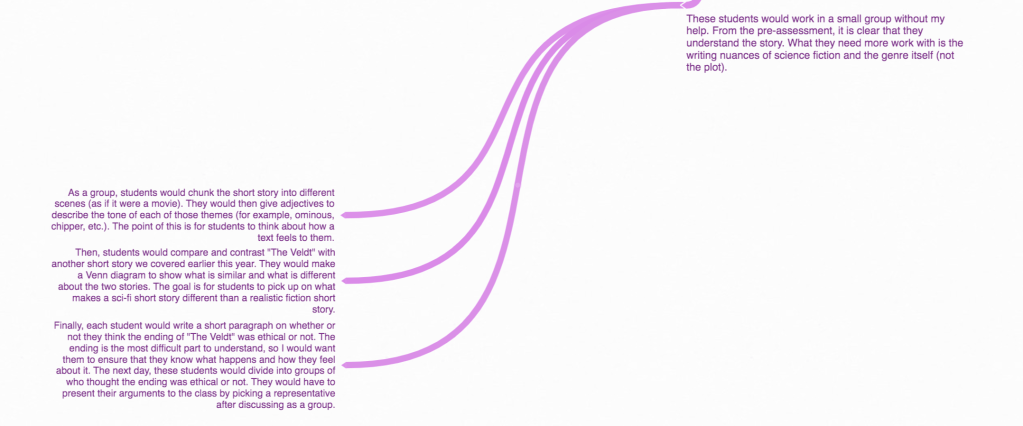
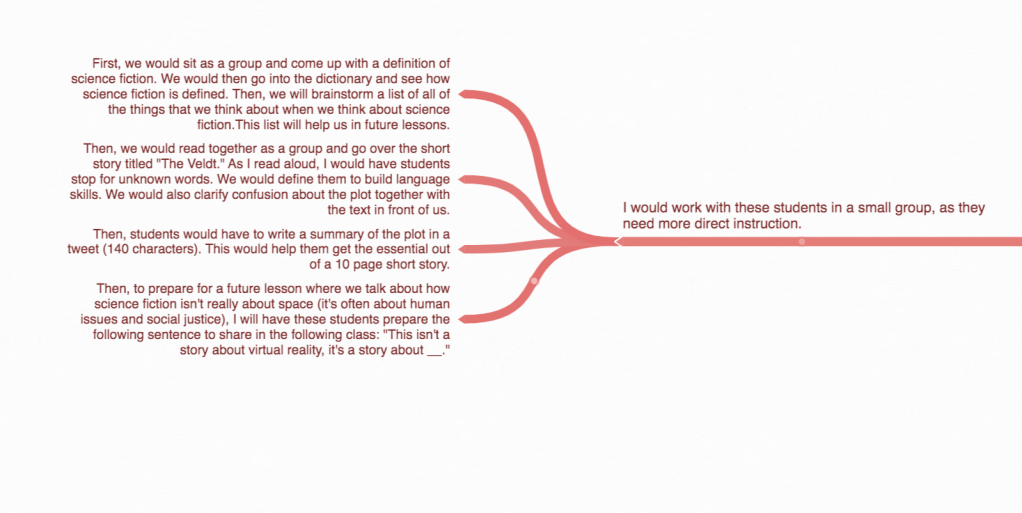
Here is the flowchart that I made to show how instruction would vary based on the pre-assessment results:
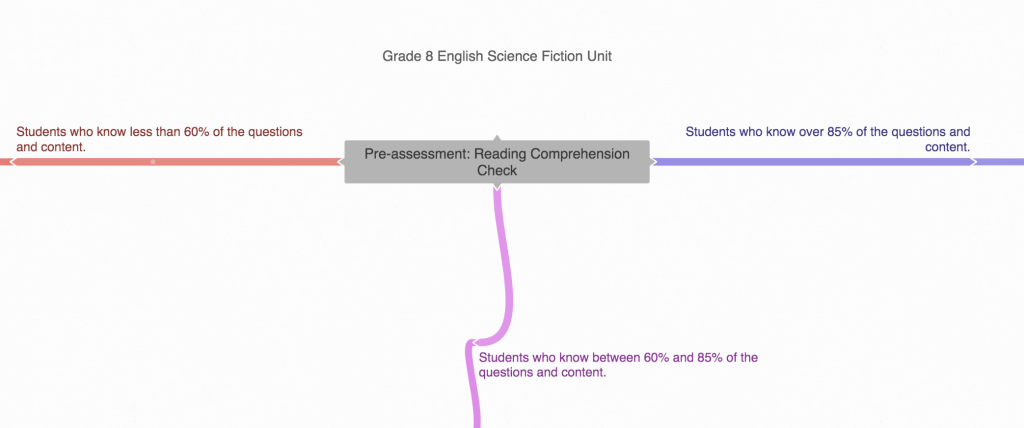
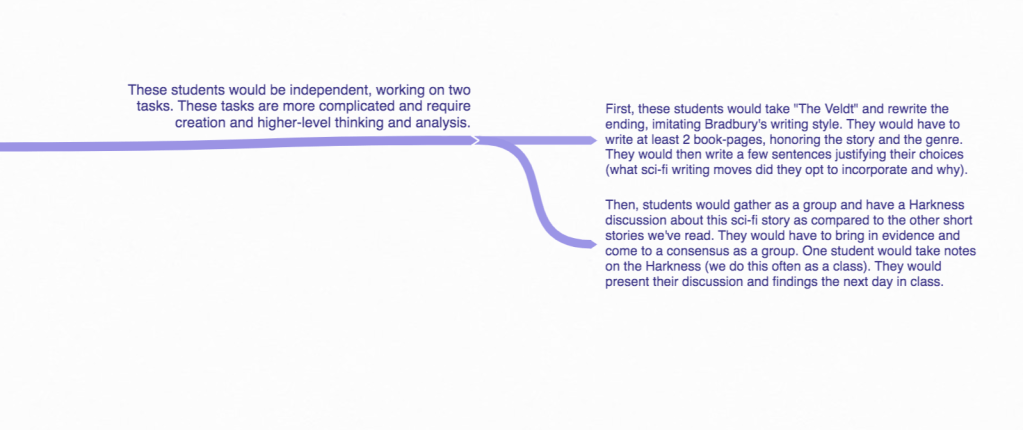
Center of my flowchart
For students who got more than 85%
For students who got between 60 and 85%
For students who got less than 60%

You can also click here to see the flowchart!

Here are the ways in which I would track progress:
For students in Group 1, their progress would appear in two ways. First, their rewriting of the ending of “The Veldt” would show me how they can observe writing techniques for sci-fi and apply these techniques themselves. Their justification sentences would show me what they were aiming to create. I would be able to see how successfully they were able to apply these techniques. Then, their Harkness notes would show me how they work with others to develop a group-understanding of genre.

For students in Group 2, I would see their progress in their Venn Diagram and the paragraphs they write. I want to see them move away from basic reading comprehension and move into analysis. Making a claim about an ending as ethical or not helps them build argumentation skills. Comparing stories and then articulating those differences would help me see how they learn to identify what makes sci-fi unique.

For students in Group 3, I would see their progress through our discussion of the story and through the tweets they write. I would also have them retake the pre-assessment to see if they can show that they grew.

Here is how I would meet the needs of my ELL and special needs students:

There are several ways in which I would support students who are ELL or have special needs. For ELL students, I would allow them to have dictionaries and ask clarifying questions (both for the pre-assessment and the activities that follow). If they are unable to use words to show what they know, I would let them draw it out. As for genre, I think that I would ask students to explore sci-fi on YouTube to get a better idea of what it means. I would ask them if they’ve encountered sci-fi in their native language (movies, tv, books). This would help the abstract discussion feel more accessible.

For students with special needs, I would offer them the chance to speak what they know, rather than write it. Often, it is easier for students to share reading comprehension when it feels like a conversation. Every time, while reading, that they felt something big happened in the plot, I would ask them to stop me and we would discuss it. Furthermore, I would allow special needs students more time to take the pre-assessment. If any of these students struggle with maintaining attention, I would call in a member of our Learning Center so that they wouldn’t have to sit in the Group 3 read aloud of the story. In this way, they could read at their own pace and take breaks to move around as needed.
Data-based Modifications of Formative Assessments

I received feedback as well as read and participated in the Discussion Forum. Now what?

One of the things that I appreciate most about working with our Cohort is how supportive everyone is. Often, when I share ideas that I have for activities or forms of formative assessments, I feel unsure of myself. I think that one of the benefits of getting feedback from partners and the forum is that members of our Cohort are able to point out strengths or positive aspects of my work. Likewise, I appreciate our culture of sharing for it pushes me to be a better teacher.

In this activity, I received some very helpful feedback from my two partners, from how specific my instructions were to the possible sensitive nature of the poems I picked to the length of time the formative assessments would take.

Furthermore, in reading and participating in the Discussion Forum, I realized some additional things:
– Websites like Kahoot and Quizlet can help students become extremely motivated. Gamification can really make assessment feel less stressful and more empowering. Sarika wrote about her experience watching her children use Quizlet. I’d love for my formative assessment to be something that students look forward to doing.
– It is easy to avoid tracking growth, as we often are deeply familiar with how students are doing. That said, tracking the growth actively can be important for record-keeping and for students to see proof of how they have changed.

How will I change my assessments?

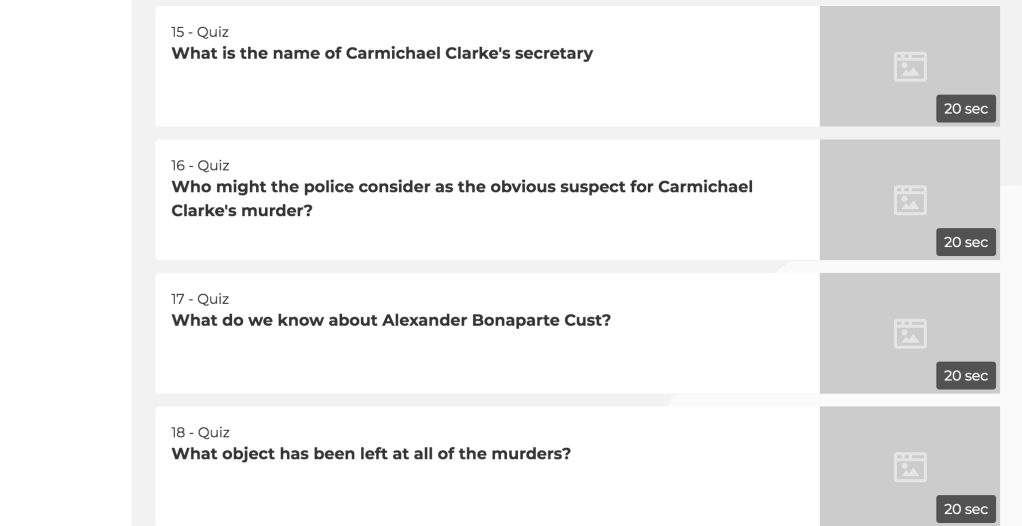
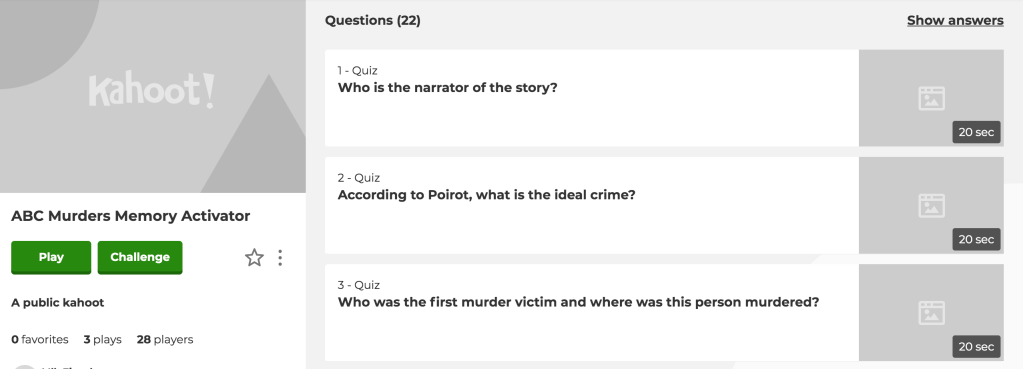
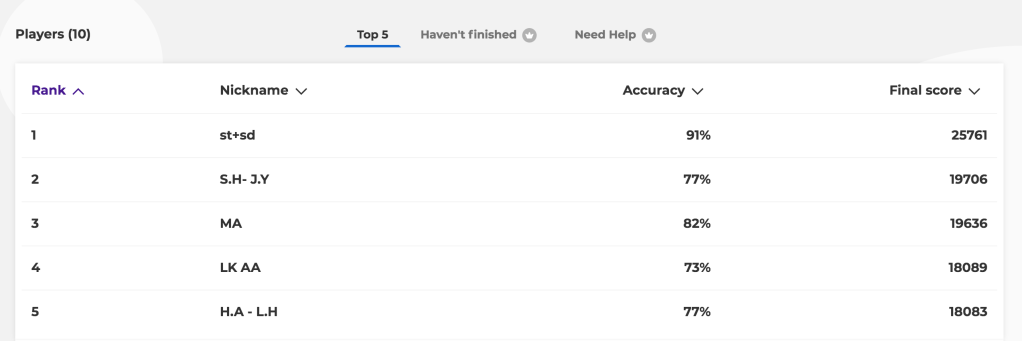
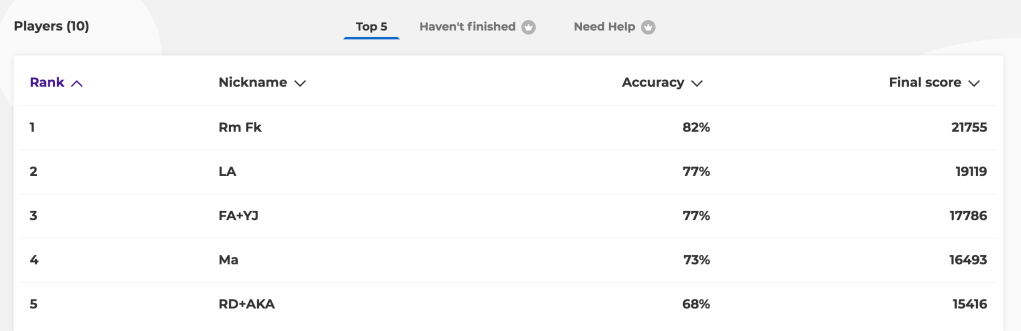
For my Reading Checks assessment, I still think that they are a good idea. That said, I wanted to incorporate some more gamification so that it is not always a written reading check of three questions. I think reading checks can be great for a quick gauge of how students are doing. I will continue to use them and track them on Google Drive. In addition, I made a Kahoot to summarize all of the important information from the first half of the book. I tried it out with my students and they adored it. They blew me away. Not only were they enthusiastic about the activity (they are extremely competitive), but also they were eager to explain how they knew the correct answers. They shocked me with how much they were able to recall. I think this was a great way to take my original formative assessment and vary it for fun and complexity (and ease of gathering data). Here are some screenshots of results and example questions:

As for my poetry formative assessment, I think that I would want to make it a bit more quick and easy to assess. My idea of a Yes/No/Maybe chart feels more like an appropriate activity to do during the study of the poem. I think I could then shift to a formative assessment where students put dots next to what they believe about the poem or not. This is not to say that I want to get rid of my proposed formative assessment. Rather, I think that what I first proposed helps students articulate what they know/don’t know. Changing this assessment to be a bit more structured and targeted with specific questions would allow me to see if students know certain things I want them to take away from the poem.

Alternatively, I could use a method called “Four Corners” to make statements about the poem and then have students go to a corner if they agree or disagree. Then, they’d have to justify their answer. My students love to debate, and this formative assessment would allow me to gauge their understanding. Here is a great video speaking to this type of activity:

Finally, for my Ed Puzzle, I would need to figure out a way to clarify time expectations. Perhaps I could allow students to do an initial attempt in class under a timed expectation. Then, they could go back home to return to the parts they didn’t understand.

All in all, I’m looking forward to fine-tuning my formative assessments. I think they are crucial both for me and for my students to understand where they are.

Assessing Project Based Learning

I decided to work with my AP French art project. My students are in grades 10-12 and are able to do quite a bit of self-directing. Projects like these enable me to provide students with choice and to help them build critical planning and project-execution skills. For this project, students are working in French to analyze a French artist, make artwork inspired by that artist, and present and defend their choices and work.

Project objectives:

  1. Vocabulary acquisition: Because this course is an AP course, it is important that students develop an understanding and vocabulary for the six themes of the French exam. One of these themes is “Beauty and Aesthetics.” Thus, an objective is for students to learn how to talk about and analyze art in French. In other words, I will be looking to see if students learn the lexicon related to art and the analysis of art. Can they use the proper and specific technical vocabulary?
  2. Justification and analytical skills: I would like for students to work on their written and spoken French skills, particularly when it comes to forming and justifying an argument. My objective in this regard is that students are able to summarize and put forth a written analysis in French. Then, they will work on explaining and justifying their choices to the audience that will watch their presentations.
  3. Curiosity and knowledge: As this course is all about both the French language and the Francophone world, the objectives must move beyond French language skills. My final objective is for students to gain an in-depth understanding of a Francophone artist and this person’s influence on the world. Then, it is my hope that students will get to be creative and explore this art through their own creative production.

Project description: After having studied art on a general level in class, students will pick one type of art to dive into. They will research and write an analysis of a Francophone artist (detailing biography and characteristics of the artist’s work). They will then create art inspired by the artist they studied, justifying their choices in a written paragraph. Finally, they will share their work with a visual and oral presentation open to the entire school. Students and teachers from the school will attend this presentation and ask questions in English and French.

The options are the following artistic tracks:

  1. Poetry: studying a poet and writing a poem
  2. Music: studying a musician and writing a song
  3. Painting: studying a painter and making a painting OR curating an exhibit
  4. Film: studying a filmmaker and making a short film

There are three pieces that the student produce during this project:

  1. 1.5-2 page written analysis of their artist
  2. Creative work inspired by their artist and a paragraph justifying their choices
  3. A presentation with visual and oral aspects

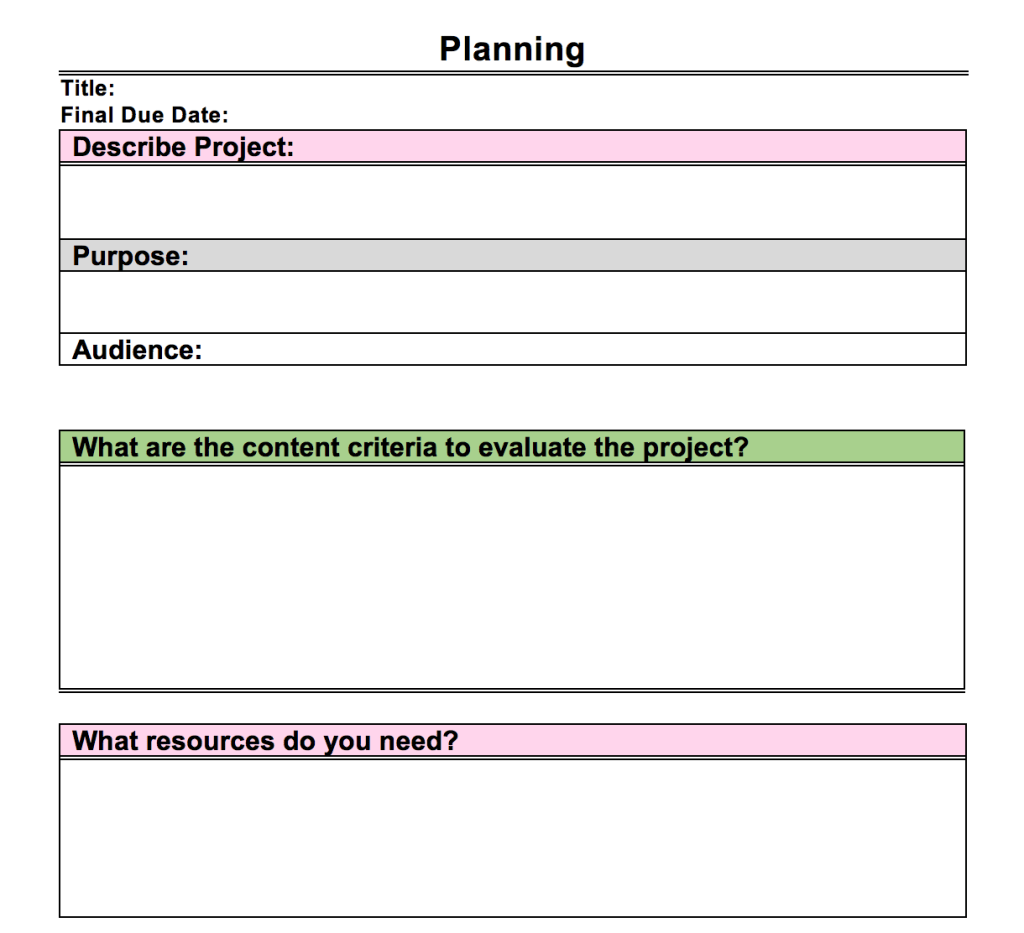
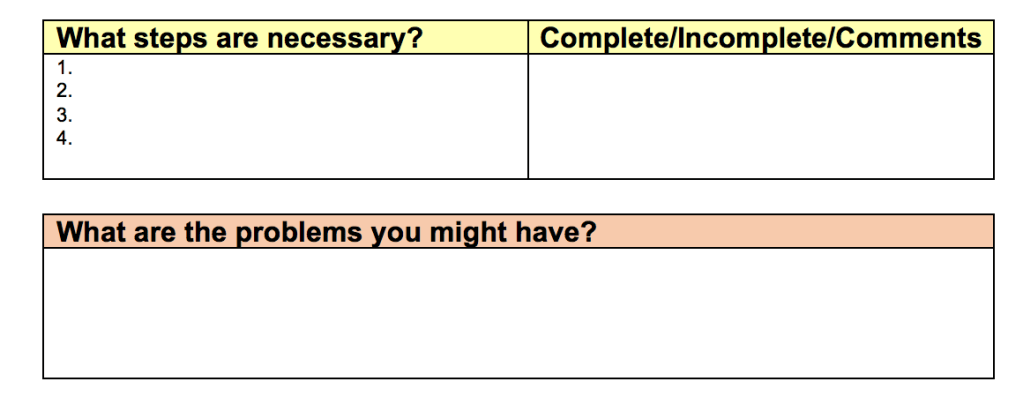
Students direct their own project during class. We spend a lot of time working on creating class-wide research questions and criteria for decision making. Then, we create a planning packet that asks students to think about what materials they will need and what the deadlines mean for their process. Here are some examples from that packet:

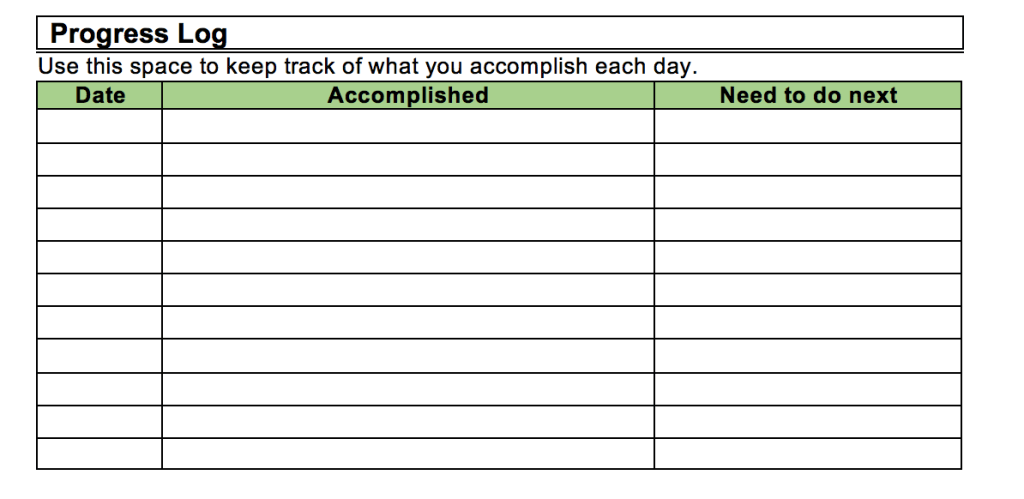
In order to have students push their project forward, I create this activity log. They set a daily goal for themselves and then report back on whether or not they have accomplished this goal. We talk about what it means to set good goals (using the SMART acronym– Specific, Measurable, Achievable, Realistic, and Timely). In this way, I can monitor student progress.

This is the progress log that students fill out every day to reflect on what they accomplished and what they will do the next class.

Figuring out how to go about such a big project can be daunting. I create a lot of resources and place them on our Google Classroom so that students can use templates for research.

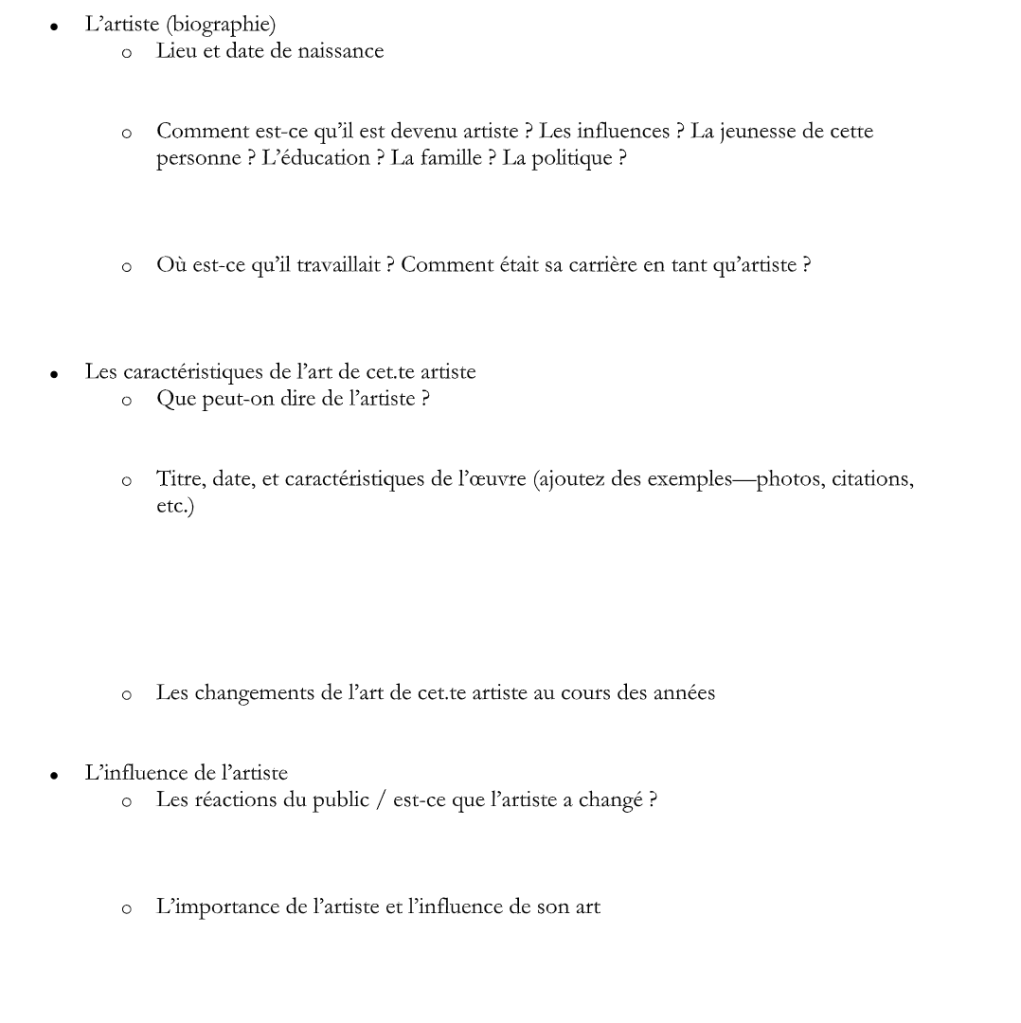
For example, this is a document that replicates the suggested structure of the analysis of an artist. The three main bullet points represent the three paragraphs. There are guiding questions and the key information that students need to provide. This document allows them to paste their ideas and begin to sketch out a rough draft. I believe this helps them organize their work and reflect on the structure of their writing.

In addition, students have certain dates where they have to hand in rough drafts (not graded) for feedback. We set these dates together as a class, after having discussed the final presentation date. In this way, the deadlines feel more democratic and students understand and accept the pacing of the project. Also, this is how I assess learning and progress throughout the project. Each of these pieces help me see how students are doing (in addition to the one-on-one conferencing I do with them during class). For my current class, this is the pacing we agreed on:

  • Hand in the rough draft of the artistic analysis — receive feedback and revise (January 14)
  • Hand in the final draft of the artistic analysis (January 16)
  • Hand in the rough draft of the creative production — receive feedback and revise (January 21)
  • Hand in the final draft of the creative production (January 23)
  • Practice the visual and oral presentation — receive feedback and revise (January 26)
  • Perform the final visual and oral presentation. (January 28)

What does the feedback that I give look like during the rough draft stages? I provide clear written suggestions on trends in grammar mistakes and areas for strengthening content. Then, I meet with students one-on-one to discuss their ideas and how they can push their work further. We set a game plan together so that they have to tell me what 2-3 concrete steps they will take for revisions.

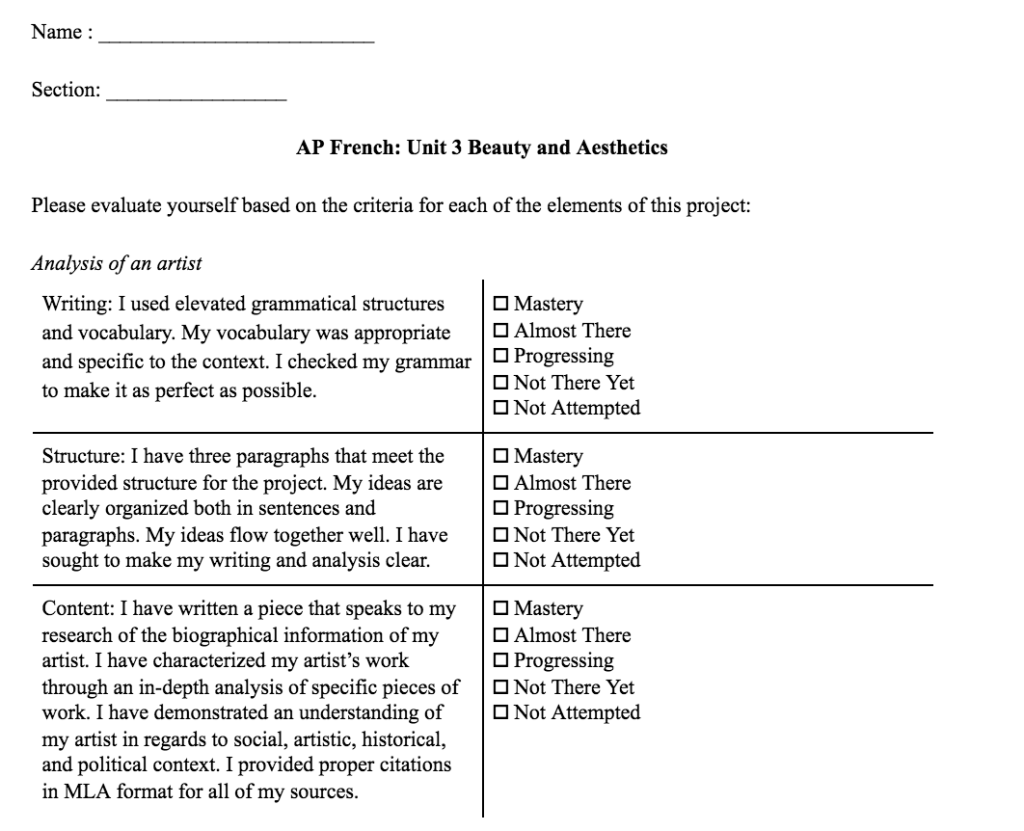
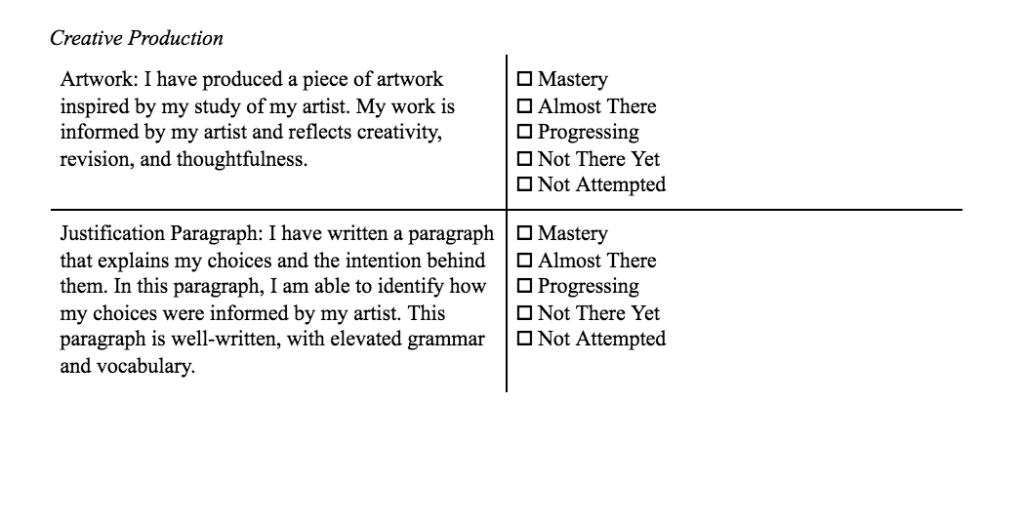
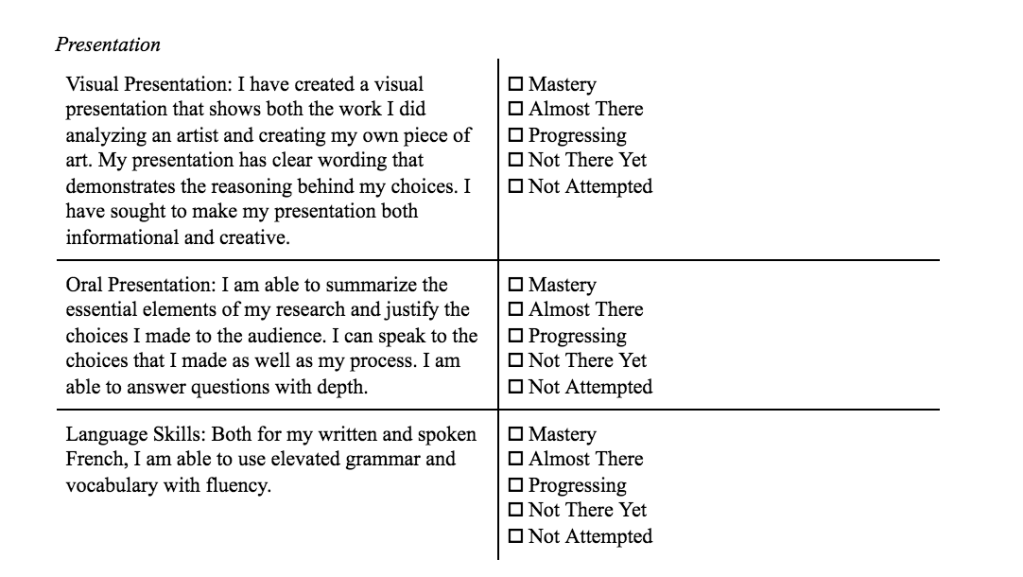
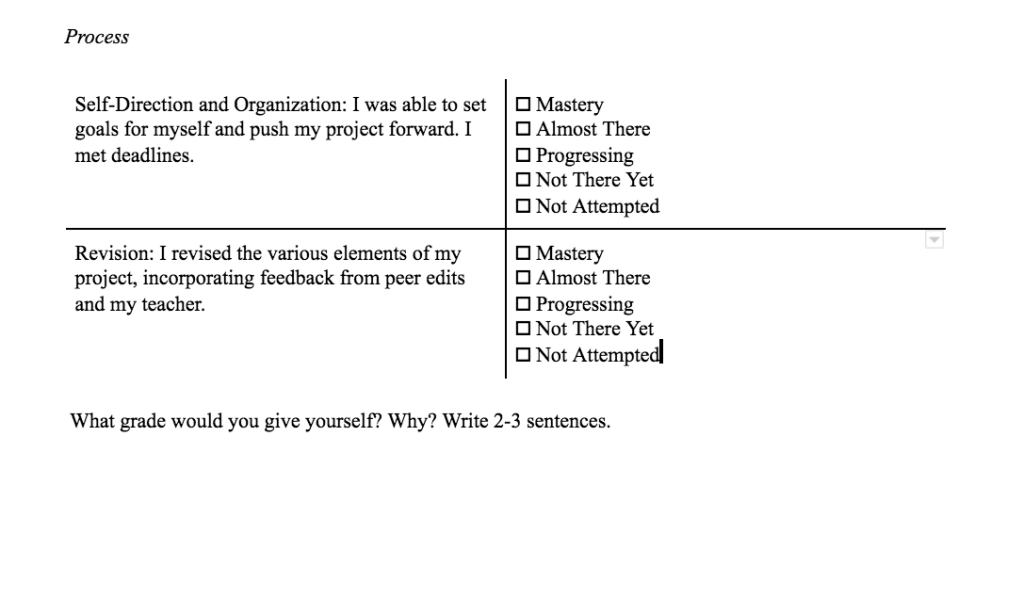
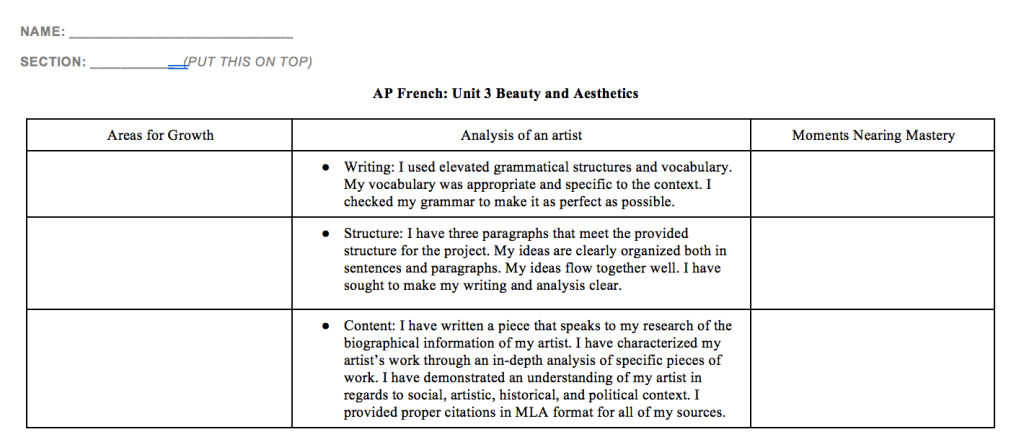
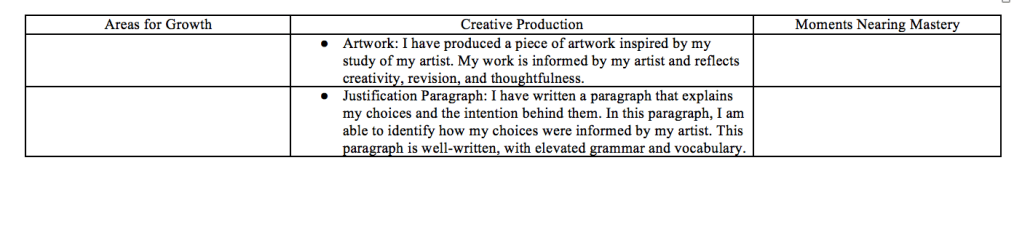
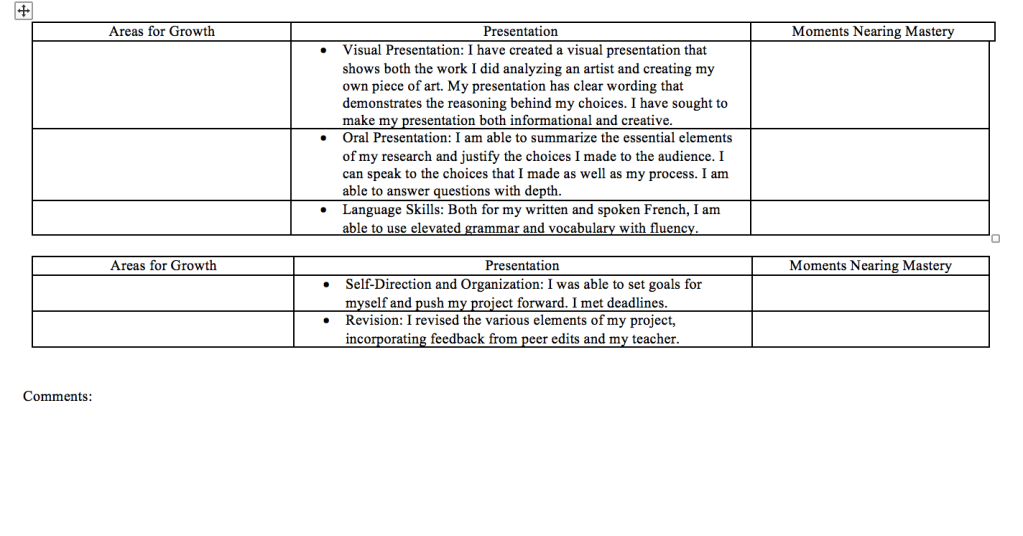
The feedback that I give during the final draft stages is based on a single-point rubric that students help me create. We work together to determine the criteria for evaluation. Students self-assess on a mastery spectrum scale. They have to justify the grade that they think they earned. Then, I fill out the single-point rubric to highlight areas of growth for each criteria and areas close to mastery.

Here are screenshots of the example of the rubric that students fill out for themselves:

Here is a PDF download of the student rubric that allows for them to self-evaluate:

Here is the example of the single-point rubric that I fill out. The criteria are the same. Instead of checking boxes, I write areas for growth and areas of strength for each point.

Here is a PDF download of the single-point rubric that I use to evaluate:

Design a site like this with WordPress.com
Get started